> ## Documentation Index
> Fetch the complete documentation index at: https://cantonfoundation-delegation-propose-accept.mintlify.site/llms.txt
> Use this file to discover all available pages before exploring further.
# Composition and Design Patterns
> Compose multi-step transactions, understand Daml's execution model and privacy, and apply common multi-party workflow patterns
# Compose choices
It's time to put everything you've learned so far together into a complete and secure Daml model for asset issuance, management, transfer, and trading. This application will have capabilities similar to the one in the [CN Quickstart](/sdks-tools/reference-projects/cn-quickstart). In the process you will learn about a few more concepts:
* Daml projects, packages, and modules
* Composition of transactions
* Observers and stakeholders
* Daml's execution model
* Privacy
The model in this section is not a single Daml file, but a Daml project consisting of several files that depend on each other.
Remember that you can load all the code for this section into a folder called `intro-compose` by running `dpm new intro-compose --template daml-intro-compose`
## Daml projects
Daml is organized in projects, packages, and modules. A Daml project is specified using a single `daml.yaml` file, and compiles into a package in Daml's intermediate language, or bytecode equivalent, Daml-LF. Each Daml file within a project becomes a Daml module, which is a bit like a namespace. Each Daml project has a source root specified in the `source` parameter in the project's `daml.yaml` file. The package will include all modules specified in `*.daml` files beneath that source directory.
You can start a new project with a skeleton structure using `dpm new project-name` in the terminal. A minimal project would contain just a `daml.yaml` file and an empty directory of source files.
> Take a look at the `daml.yaml` for the this chapter's project:
```yaml theme={"theme":{"light":"github-light","dark":"github-dark"}}
sdk-version: __VERSION__
name: __PROJECT_NAME__
source: daml
version: 1.0.0
dependencies:
- daml-prim
- daml-stdlib
- daml-script
```
You can generally set `name` and `version` freely to describe your project. `dependencies` does what the name suggests: it includes dependencies. You should always include `daml-prim` and `daml-stdlib`. The former contains internals of the compiler and the Daml Runtime, the latter gives access to the Daml standard library. `daml-script` contains the types and functions for Daml Script.
You compile a Daml project by running `dpm build` from the project root directory. This creates a DAR file in `.daml/dist/dist/${project_name}-${project_version}.dar`. A DAR file is Daml's equivalent of a JAR file in Java: it's the artifact that gets deployed to a ledger to load the package and its dependencies. `dar` files are fully self-contained in that they contain all dependencies of the main package. More on all of this in [Building and Packaging](/appdev/modules/m3-building-packaging).
## Project structure
This project contains an asset holding model for transferable, fungible assets and a separate trade workflow. The templates are structured in three modules: `Intro.Asset`, `Intro.Asset.Role`, and `Intro.Asset.Trade`.
In addition, there are tests in modules `Test.Intro.Asset`, `Test.Intro.Asset.Role`, and `Test.Intro.Asset.Trade`.
All but the last `.`-separated segment in module names correspond to paths relative to the project source directory, and the last one to a file name. The folder structure therefore looks like this:
```none theme={"theme":{"light":"github-light","dark":"github-dark"}}
.
├── daml
│ ├── Intro
│ │ ├── Asset
│ │ │ ├── Role.daml
│ │ │ └── Trade.daml
│ │ └── Asset.daml
│ └── Test
│ └── Intro
│ ├── Asset
│ │ ├── Role.daml
│ │ └── Trade.daml
│ └── Asset.daml
└── daml.yaml
```
Each file contains a module header. For example, `daml/Intro/Asset/Role.daml`:
```haskell theme={"theme":{"light":"github-light","dark":"github-dark"}}
module Intro.Asset.Role where
```
You can import one module into another using the `import` keyword. The `LibraryModules` module imports all six modules:
```haskell theme={"theme":{"light":"github-light","dark":"github-dark"}}
import Intro.Asset
```
Imports always have to appear just below the module declaration. You can optionally add a list of names after the import to import only the selected names:
```haskell theme={"theme":{"light":"github-light","dark":"github-dark"}}
import DA.List (sortOn, groupOn)
```
If your module contains any Daml Scripts, you need to import the corresponding functionality:
```haskell theme={"theme":{"light":"github-light","dark":"github-dark"}}
import Daml.Script
```
## Project overview
The project both changes and adds to the `Iou` model presented in [Authorization](/appdev/modules/m3-authorization):
* Assets are fungible in the sense that they have `Merge` and `Split` choices that allow the `owner` to manage their holdings.
* Transfer proposals now need the authorities of both `issuer` and `newOwner` to accept. This makes `Asset` safer than `Iou` from the issuer's point of view.
With the `Iou` model, an `issuer` could end up owing cash to anyone as transfers were authorized by just `owner` and `newOwner`. In this project, only parties having an `AssetHolder` contract can end up owning assets. This allows the `issuer` to determine which parties may own their assets.
* The `Trade` template adds a swap of two assets to the model.
## Composed choices and scripts
This project showcases how you can put the `Update` and `Script` actions you learned about in [Authorization](/appdev/modules/m3-authorization) to good use. For example, the `Merge` and `Split` choices each perform several actions in their consequences.
* Two create actions in case of `Split`
* One create and one archive action in case of `Merge`
```haskell theme={"theme":{"light":"github-light","dark":"github-dark"}}
choice Split
: SplitResult
with
splitQuantity : Decimal
controller owner
do
splitAsset <- create this with
quantity = splitQuantity
remainder <- create this with
quantity = quantity - splitQuantity
return SplitResult with
splitAsset
remainder
choice Merge
: ContractId Asset
with
otherCid : ContractId Asset
controller owner
do
other <- fetch otherCid
assertMsg
"Merge failed: issuer does not match"
(issuer == other.issuer)
assertMsg
"Merge failed: owner does not match"
(owner == other.owner)
assertMsg
"Merge failed: symbol does not match"
(symbol == other.symbol)
archive otherCid
create this with
quantity = quantity + other.quantity
```
The `return` function used in `Split` is available in any `Action` context. The result of `return x` is a no-op containing the value `x`. It has an alias `pure`, indicating that it's a pure value, as opposed to a value with side-effects. The `return` name makes sense when it's used as the last statement in a `do` block as its argument is indeed the "return"-value of the `do` block in that case.
Taking transaction composition a step further, the `Trade_Settle` choice on `Trade` composes two `exercise` actions:
```haskell theme={"theme":{"light":"github-light","dark":"github-dark"}}
choice Trade_Settle
: (ContractId Asset, ContractId Asset)
with
quoteAssetCid : ContractId Asset
baseApprovalCid : ContractId TransferApproval
controller quoteAsset.owner
do
fetchedBaseAsset <- fetch baseAssetCid
assertMsg
"Base asset mismatch"
(baseAsset == fetchedBaseAsset with
observers = baseAsset.observers)
fetchedQuoteAsset <- fetch quoteAssetCid
assertMsg
"Quote asset mismatch"
(quoteAsset == fetchedQuoteAsset with
observers = quoteAsset.observers)
transferredBaseCid <- exercise
baseApprovalCid TransferApproval_Transfer with
assetCid = baseAssetCid
transferredQuoteCid <- exercise
quoteApprovalCid TransferApproval_Transfer with
assetCid = quoteAssetCid
return (transferredBaseCid, transferredQuoteCid)
```
The resulting transaction, with its two nested levels of consequences, can be seen in the `test_trade` script in `Test.Intro.Asset.Trade`:
```none theme={"theme":{"light":"github-light","dark":"github-dark"}}
TX 14 1970-01-01T00:00:00Z (Test.Intro.Asset.Trade:79:23)
#14:0
│ disclosed to (since): 'Alice' (14), 'Bob' (14)
└─> 'Bob' exercises Trade_Settle on #12:0 (Intro.Asset.Trade:Trade)
with
quoteAssetCid = #9:1; baseApprovalCid = #13:1
children:
#14:1
│ disclosed to (since): 'Alice' (14), 'Bob' (14), 'USD_Bank' (14)
└─> 'Alice' and 'USD_Bank' fetch #10:1 (Intro.Asset:Asset)
#14:2
│ disclosed to (since): 'Alice' (14), 'Bob' (14), 'EUR_Bank' (14)
└─> 'Bob' and 'EUR_Bank' fetch #9:1 (Intro.Asset:Asset)
#14:3
│ disclosed to (since): 'Alice' (14), 'Bob' (14), 'USD_Bank' (14)
└─> 'Alice' and 'Bob' exercise TransferApproval_Transfer on #13:1 (Intro.Asset:TransferApproval)
with
assetCid = #10:1
children:
#14:4
│ disclosed to (since): 'Alice' (14), 'Bob' (14), 'USD_Bank' (14)
└─> 'Alice' and 'USD_Bank' fetch #10:1 (Intro.Asset:Asset)
#14:5
│ disclosed to (since): 'Alice' (14), 'Bob' (14), 'USD_Bank' (14)
└─> 'Alice' and 'USD_Bank' exercise Archive on #10:1 (Intro.Asset:Asset)
#14:6
│ disclosed to (since): 'Alice' (14), 'Bob' (14), 'USD_Bank' (14)
└─> 'Bob' and 'USD_Bank' create Intro.Asset:Asset
with
issuer = 'USD_Bank';
owner = 'Bob';
symbol = "USD";
quantity = 100.0000000000;
observers = []
#14:7
│ disclosed to (since): 'Alice' (14), 'Bob' (14), 'EUR_Bank' (14)
└─> 'Alice',
'Bob' exercises TransferApproval_Transfer on #11:1 (Intro.Asset:TransferApproval)
with
assetCid = #9:1
children:
#14:8
│ disclosed to (since): 'Alice' (14), 'Bob' (14), 'EUR_Bank' (14)
└─> 'Bob' and 'EUR_Bank' fetch #9:1 (Intro.Asset:Asset)
#14:9
│ disclosed to (since): 'Alice' (14), 'Bob' (14), 'EUR_Bank' (14)
└─> 'Bob' and 'EUR_Bank' exercise Archive on #9:1 (Intro.Asset:Asset)
#14:10
│ disclosed to (since): 'Alice' (14), 'Bob' (14), 'EUR_Bank' (14)
└─> 'Alice' and 'EUR_Bank' create Intro.Asset:Asset
with
issuer = 'EUR_Bank';
owner = 'Alice';
symbol = "EUR";
quantity = 90.0000000000;
observers = []
```
Similar to choices, you can see how the scripts in this project are built up from each other:
```haskell theme={"theme":{"light":"github-light","dark":"github-dark"}}
test_issuance = do
setupResult@(alice, bob, bank, aha, ahb) <- setupRoles
assetCid <- submit bank do
exerciseCmd aha Issue_Asset
with
symbol = "USD"
quantity = 100.0
Some asset <- queryContractId bank assetCid
assert (asset == Asset with
issuer = bank
owner = alice
symbol = "USD"
quantity = 100.0
observers = []
)
return (setupResult, assetCid)
```
In the above, the `test_issuance` script in `Test.Intro.Asset.Role` uses the output of the `setupRoles` script in the same module.
The same line shows a new kind of pattern matching. Rather than writing `setupResult <- setupRoles` and then accessing the components of `setupResult` using `_1`, `_2`, etc., you can give them names. It's equivalent to writing:
```haskell theme={"theme":{"light":"github-light","dark":"github-dark"}}
setupResult <- setupRoles
case setupResult of
(alice, bob, bank, aha, ahb) -> ...
```
Just writing `(alice, bob, bank, aha, ahb) <- setupRoles` would also be legal, but `setupResult` is used in the return value of `test_issuance` so it makes sense to give it a name, too. The notation with `@` allows you to give both the whole value as well as its constituents names in one go.
## Daml's execution model
Daml's execution model is fairly easy to understand, but has some important consequences. You can imagine the life of a transaction as follows:
1. **Command submission**: A user submits a list of commands via the Ledger API of a participant node, acting as a `Party` hosted on that node. That party is called the requester.
2. **Interpretation**: Each command corresponds to one or more actions. During this step, the `Update` corresponding to each action is evaluated in the context of the ledger to calculate all consequences, including transitive ones (consequences of consequences, etc.). The result of this is a complete transaction. Together with its requestor, this is also known as a commit.
3. **Blinding**: On ledgers with strong privacy, projections (see [Privacy Model](/overview/learn/privacy-model)) for all involved parties are created. This is also called *projecting*.
4. **Transaction submission**: The transaction/commit is submitted to the network.
5. **Validation**: The transaction/commit is validated by the network. Who exactly validates can differ from implementation to implementation. Validation also involves scheduling and collision detection, ensuring that the transaction has a well-defined place in the (partial) ordering of commits, and no double spends occur.
6. **Commitment**: The commit is actually committed according to the commit or consensus protocol of the ledger.
7. **Confirmation**: The network sends confirmations of the commitment back to all involved participant nodes.
8. **Completion**: The user gets back a confirmation through the Ledger API of the submitting participant node.
The first important consequence of the above is that all transactions are committed atomically. Either a transaction is committed as a whole and for all participants, or it fails.
That's important in the context of the `Trade_Settle` choice shown above. The choice transfers a `baseAsset` one way and a `quoteAsset` the other way. Thanks to transaction atomicity, there is no chance that either party is left out of pocket.
The second consequence is that the requester of a transaction knows all consequences of their submitted transaction -- there are no surprises in Daml. However, it also means that the requester must have all the information to interpret the transaction. We also refer to this as Principle 2 a bit later on this page.
That's also important in the context of `Trade`. In order to allow Bob to interpret a transaction that transfers Alice's cash to Bob, Bob needs to know both about Alice's `Asset` contract, as well as about some way for `Alice` to accept a transfer -- remember, accepting a transfer needs the authority of `issuer` in this example.
## Observers
*Observers* are Daml's mechanism to disclose contracts to other parties. They are declared just like signatories, but using the `observer` keyword, as shown in the `Asset` template:
```haskell theme={"theme":{"light":"github-light","dark":"github-dark"}}
template Asset
with
issuer : Party
owner : Party
symbol : Text
quantity : Decimal
observers : [Party]
where
signatory issuer, owner
ensure quantity > 0.0
observer observers
```
The `Asset` template also gives the `owner` a choice to set the observers, and you can see how Alice uses it to show her `Asset` to Bob just before proposing the trade. You can try out what happens if she didn't do that by removing that transaction:
```haskell theme={"theme":{"light":"github-light","dark":"github-dark"}}
usdCid <- submit alice do
exerciseCmd usdCid SetObservers with
newObservers = [bob]
```
Observers have guarantees in Daml. In particular, they are guaranteed to see actions that create and archive the contract on which they are an observer.
Since observers are calculated from the arguments of the contract, they always know about each other. That's why, rather than adding Bob as an observer on Alice's `AssetHolder` contract, and using that to authorize the transfer in `Trade_Settle`, Alice creates a one-time authorization in the form of a `TransferAuthorization`. If Alice had lots of counterparties, she would otherwise end up leaking them to each other.
Choice controllers are not automatically made observers, as they can only be calculated at the point in time when the choice arguments are known.
## Privacy
Daml's privacy model is based on two principles:
Principle 1. Parties see those actions that they have a stake in. Principle 2. Every party that sees an action sees its (transitive) consequences.
Principle 2 is necessary to ensure that every party can independently verify the validity of every transaction they see.
A party has a stake in an action if
* they are a required authorizer of it
* they are a signatory of the contract on which the action is performed
* they are an observer on the contract, and the action creates or archives it
What does that mean for the `exercise tradeCid Trade_Settle` action from `test_trade`?
Alice is the signatory of `tradeCid` and Bob a required authorizer of the `Trade_Settled` action, so both of them see it. According to principle 2 above, that means they get to see everything in the transaction.
The consequences contain, next to some `fetch` actions, two `exercise` actions of the choice `TransferApproval_Transfer`.
Each of the two involved `TransferApproval` contracts is signed by a different `issuer`, which see the action on "their" contract. So the EUR\_Bank sees the `TransferApproval_Transfer` action for the EUR `Asset` and the USD\_Bank sees the `TransferApproval_Transfer` action for the USD `Asset`.
Some Daml ledgers, like the script runner and the Sandbox, work on the principle of "data minimization", meaning nothing more than the above information is distributed. That is, the "projection" of the overall transaction that gets distributed to EUR\_Bank in step 4 (transaction submission) of [Daml's execution model](#damls-execution-model) would consist only of the `TransferApproval_Transfer` and its consequences.
Other implementations, in particular those on public blockchains, may have weaker privacy constraints.
### Divulgence
Note that principle 2 of the privacy model means that sometimes parties see contracts that they are not signatories or observers on. If you look at the final ledger state of the `test_trade` script, for example, you may notice that both Alice and Bob now see both assets, as indicated by the Xs in their respective columns:
| Alice | Bob | EUR\_Bank | USD\_Bank | id | status | issuer | owner | symbol | quantity |
| ----- | --- | --------- | --------- | ------ | ------ | --------- | ----- | ------ | -------- |
| X | X | - | X | #15:6 | active | USD\_Bank | Bob | USD | 100.0 |
| X | X | X | - | #15:10 | active | EUR\_Bank | Alice | EUR | 90.0 |
This is because the `create` action of these contracts are in the transitive consequences of the `Trade_Settle` action both of them have a stake in. This kind of disclosure is often called "divulgence" and needs to be considered when designing Daml models for privacy sensitive applications.
## Common Daml design patterns
Beyond the composition patterns above, this section covers common multi-party workflow patterns used in Daml. All examples below use a `Coin` asset model to illustrate each pattern.
You can check out the examples locally by running `dpm new daml-patterns --template daml-patterns`.
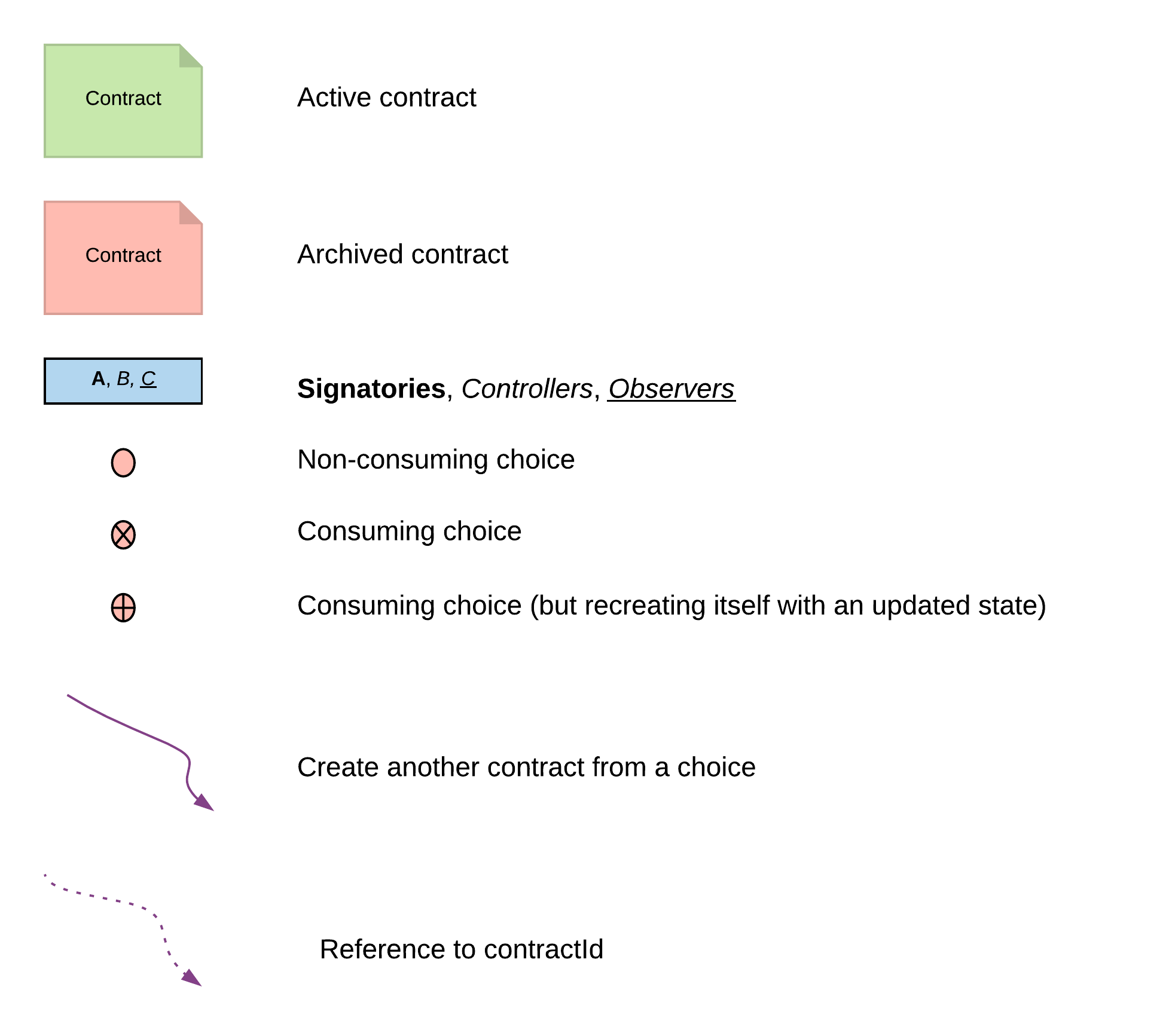
The diagrams below use a shared visual key for contracts, signatories, and choices:
 ### Propose-Accept
The most common way to get multiple parties to agree on a shared contract. One party creates a proposal contract that the other party can accept, reject, or let expire. The `IouProposal` [in the authorization module](/appdev/modules/m3-authorization#use-propose-accept-workflow-for-one-off-authorization) is another example of this pattern.
It takes two to tango, but one party has to propose. It is no different in the business world. The contractual relationship between two businesses often starts with an invite, a business proposal, a bid offering, etc.
**Invite** — When a market operator wants to set up a market, they need to go through an onboarding process in which they invite participants to sign master service agreements and fulfill different roles in the market. Receiving participants need to evaluate the rights and responsibilities of each role and respond accordingly.
**Propose** — When issuing an asset, an issuer is making a business proposal to potential buyers. The proposal lays out what is expected from buyers, and what they can expect from the issuer. Buyers need to evaluate all aspects of the offering, e.g. price, return, and tax implications, before making a decision.
The Propose and Accept pattern demonstrates how to write a Daml program to model the initiation of an inter-company contractual relationship. Daml modelers often have to follow this pattern to ensure that no participant is forced into an obligation.
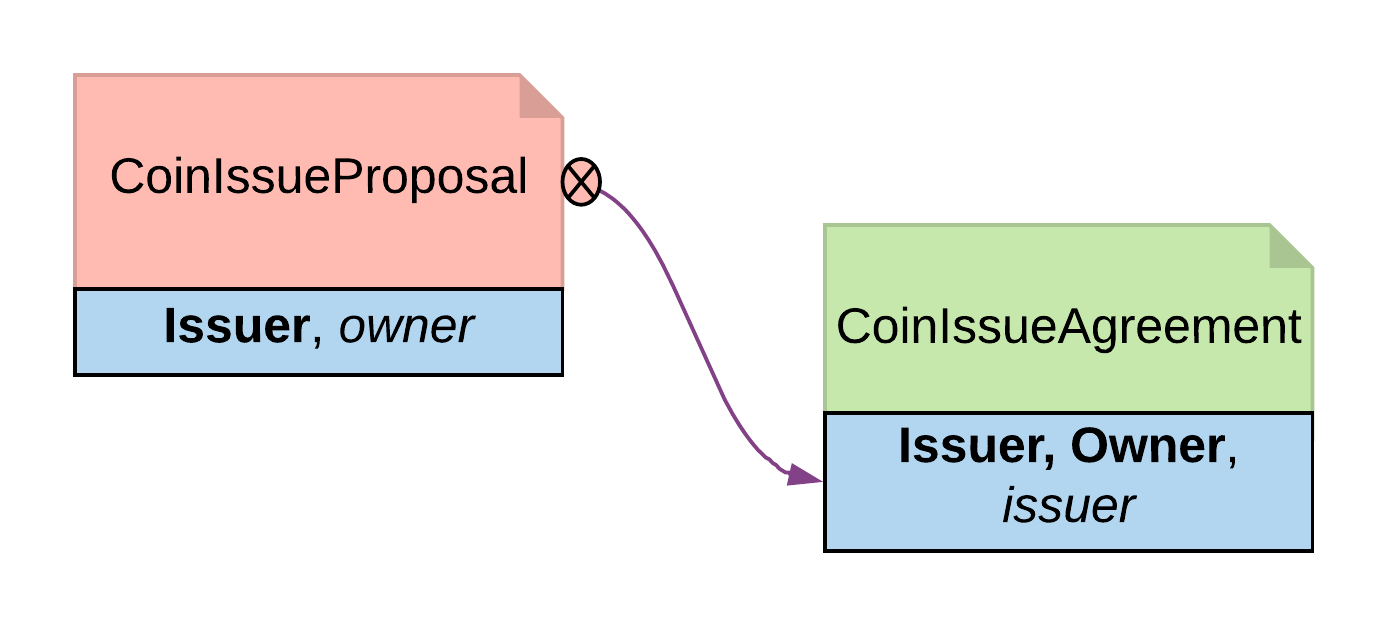
The issuer creates a `CoinMaster` contract, then uses it to invite an owner. The invitation is a proposal contract with the issuer as signatory and the owner as observer:
```haskell theme={"theme":{"light":"github-light","dark":"github-dark"}}
template CoinMaster
with
issuer: Party
where
signatory issuer
nonconsuming choice Invite : ContractId CoinIssueProposal
with owner: Party
controller issuer
do create CoinIssueProposal
with coinAgreement = CoinIssueAgreement with issuer; owner
```
The proposal gives the owner a choice to accept. In a complete model, it would also include `Reject` and `Counter` choices:
```haskell theme={"theme":{"light":"github-light","dark":"github-dark"}}
template CoinIssueProposal
with
coinAgreement: CoinIssueAgreement
where
signatory coinAgreement.issuer
observer coinAgreement.owner
choice AcceptCoinProposal
: ContractId CoinIssueAgreement
controller coinAgreement.owner
do create coinAgreement
```
When the owner accepts, the result contract has both parties as signatories — neither can be forced into the agreement without consent:
```haskell theme={"theme":{"light":"github-light","dark":"github-dark"}}
template CoinIssueAgreement
with
issuer: Party
owner: Party
where
signatory issuer, owner
nonconsuming choice Issue : ContractId Coin
with amount: Decimal
controller issuer
do create Coin with issuer; owner; amount; delegates = []
```
### Propose-Accept
The most common way to get multiple parties to agree on a shared contract. One party creates a proposal contract that the other party can accept, reject, or let expire. The `IouProposal` [in the authorization module](/appdev/modules/m3-authorization#use-propose-accept-workflow-for-one-off-authorization) is another example of this pattern.
It takes two to tango, but one party has to propose. It is no different in the business world. The contractual relationship between two businesses often starts with an invite, a business proposal, a bid offering, etc.
**Invite** — When a market operator wants to set up a market, they need to go through an onboarding process in which they invite participants to sign master service agreements and fulfill different roles in the market. Receiving participants need to evaluate the rights and responsibilities of each role and respond accordingly.
**Propose** — When issuing an asset, an issuer is making a business proposal to potential buyers. The proposal lays out what is expected from buyers, and what they can expect from the issuer. Buyers need to evaluate all aspects of the offering, e.g. price, return, and tax implications, before making a decision.
The Propose and Accept pattern demonstrates how to write a Daml program to model the initiation of an inter-company contractual relationship. Daml modelers often have to follow this pattern to ensure that no participant is forced into an obligation.
The issuer creates a `CoinMaster` contract, then uses it to invite an owner. The invitation is a proposal contract with the issuer as signatory and the owner as observer:
```haskell theme={"theme":{"light":"github-light","dark":"github-dark"}}
template CoinMaster
with
issuer: Party
where
signatory issuer
nonconsuming choice Invite : ContractId CoinIssueProposal
with owner: Party
controller issuer
do create CoinIssueProposal
with coinAgreement = CoinIssueAgreement with issuer; owner
```
The proposal gives the owner a choice to accept. In a complete model, it would also include `Reject` and `Counter` choices:
```haskell theme={"theme":{"light":"github-light","dark":"github-dark"}}
template CoinIssueProposal
with
coinAgreement: CoinIssueAgreement
where
signatory coinAgreement.issuer
observer coinAgreement.owner
choice AcceptCoinProposal
: ContractId CoinIssueAgreement
controller coinAgreement.owner
do create coinAgreement
```
When the owner accepts, the result contract has both parties as signatories — neither can be forced into the agreement without consent:
```haskell theme={"theme":{"light":"github-light","dark":"github-dark"}}
template CoinIssueAgreement
with
issuer: Party
owner: Party
where
signatory issuer, owner
nonconsuming choice Issue : ContractId Coin
with amount: Decimal
controller issuer
do create Coin with issuer; owner; amount; delegates = []
```
 This pattern can be verbose when more than two signatures are needed — see Multiple Party Agreement below for that case.
### Delegation
Gives one party the right to exercise a choice on behalf of another. The principal creates a delegation contract that authorizes an agent to act for them, without the principal committing each action. This models real-world custodian relationships where a bank holds securities and settles transactions on a client's behalf.
Delegation is prevalent in the business world. In fact, the entire custodian business is based on delegation. When a company chooses a custodian bank, it is effectively giving the bank the rights to hold their securities and settle transactions on their behalf. The securities are not legally possessed by the custodian banks, but the banks should have full rights to perform actions in the client's name, such as making payments or changing investments.
The Delegation pattern enables Daml modelers to model the real-world business contractual agreements between custodian banks and their customers. Ownership and administration rights can be segregated easily and clearly.
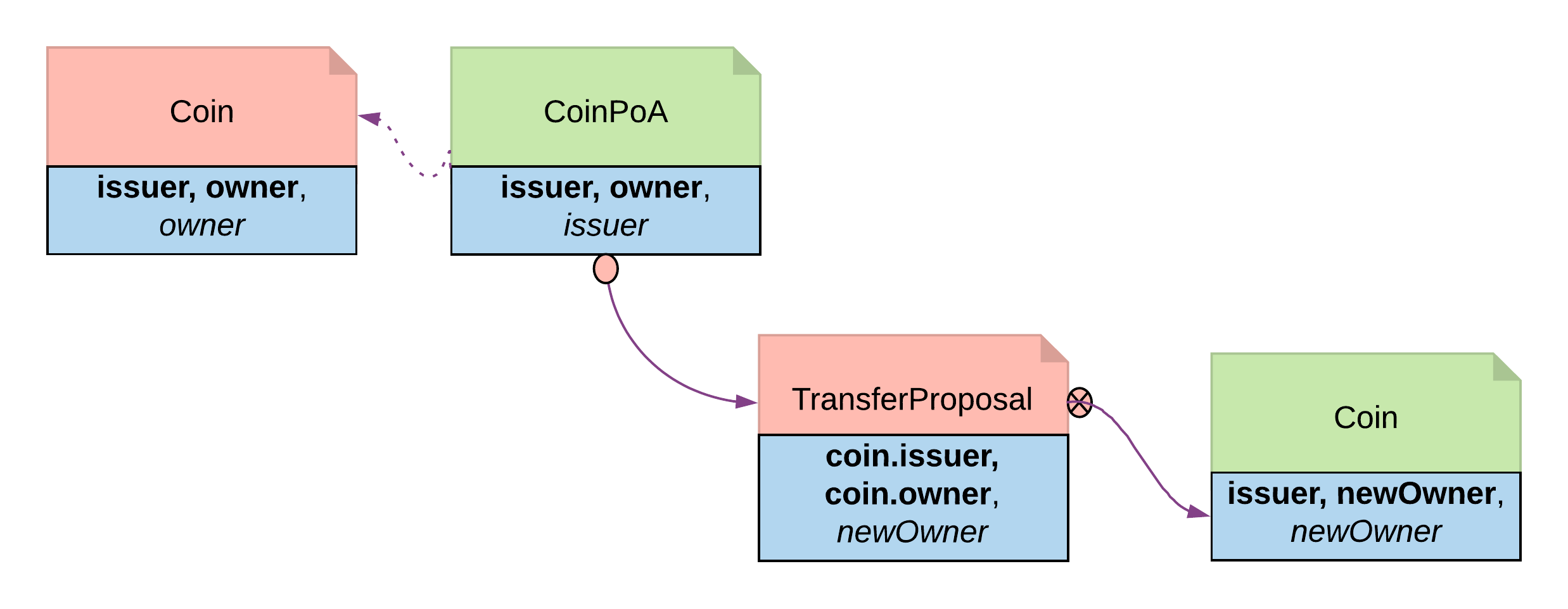
The delegation contract (`CoinPoA` — Power of Attorney) has the principal as signatory. The attorney controls a `TransferCoin` choice that exercises `Transfer` on the principal's coin:
```haskell theme={"theme":{"light":"github-light","dark":"github-dark"}}
template CoinPoA
with
attorney: Party
principal: Party
where
signatory principal
observer attorney
choice WithdrawPoA
: ()
controller principal
do return ()
-- Attorney has the delegated right to Transfer
nonconsuming choice TransferCoin
: ContractId TransferProposal
with
coinId: ContractId Coin
newOwner: Party
controller attorney
do
exercise coinId Transfer with newOwner
```
Whether or not the attorney should be a signatory of `CoinPoA` is subject to the business agreements between principal and attorney. For simplicity, in this example, the attorney is not a signatory.
The coin must be disclosed to the attorney before they can exercise the delegated choice. This is done by adding them as an observer via a `Disclose` choice on `Coin`:
```haskell theme={"theme":{"light":"github-light","dark":"github-dark"}}
choice Disclose : ContractId Coin
with p : Party
controller owner
do create this with delegates = p :: delegates
```
This pattern can be verbose when more than two signatures are needed — see Multiple Party Agreement below for that case.
### Delegation
Gives one party the right to exercise a choice on behalf of another. The principal creates a delegation contract that authorizes an agent to act for them, without the principal committing each action. This models real-world custodian relationships where a bank holds securities and settles transactions on a client's behalf.
Delegation is prevalent in the business world. In fact, the entire custodian business is based on delegation. When a company chooses a custodian bank, it is effectively giving the bank the rights to hold their securities and settle transactions on their behalf. The securities are not legally possessed by the custodian banks, but the banks should have full rights to perform actions in the client's name, such as making payments or changing investments.
The Delegation pattern enables Daml modelers to model the real-world business contractual agreements between custodian banks and their customers. Ownership and administration rights can be segregated easily and clearly.
The delegation contract (`CoinPoA` — Power of Attorney) has the principal as signatory. The attorney controls a `TransferCoin` choice that exercises `Transfer` on the principal's coin:
```haskell theme={"theme":{"light":"github-light","dark":"github-dark"}}
template CoinPoA
with
attorney: Party
principal: Party
where
signatory principal
observer attorney
choice WithdrawPoA
: ()
controller principal
do return ()
-- Attorney has the delegated right to Transfer
nonconsuming choice TransferCoin
: ContractId TransferProposal
with
coinId: ContractId Coin
newOwner: Party
controller attorney
do
exercise coinId Transfer with newOwner
```
Whether or not the attorney should be a signatory of `CoinPoA` is subject to the business agreements between principal and attorney. For simplicity, in this example, the attorney is not a signatory.
The coin must be disclosed to the attorney before they can exercise the delegated choice. This is done by adding them as an observer via a `Disclose` choice on `Coin`:
```haskell theme={"theme":{"light":"github-light","dark":"github-dark"}}
choice Disclose : ContractId Coin
with p : Party
controller owner
do create this with delegates = p :: delegates
```
 ### Authorization
Verifies that a controlling party has the right permissions before they take certain actions. An authorization contract serves as proof — the choice body checks for its existence and validity before proceeding.
Authorization is a universal concept in the business world, as access to most business resources is a privilege and not given freely. For example, security trading may seem to be a plain bilateral agreement between the two trading counterparties, but this could not be further from the truth. To be able to trade, the trading parties need to go through a series of authorization processes and gain permission from a list of service providers such as exchanges, market data streaming services, clearing houses, and security registrars.
The Authorization pattern shows how to model these authorization checks prior to a business transaction.
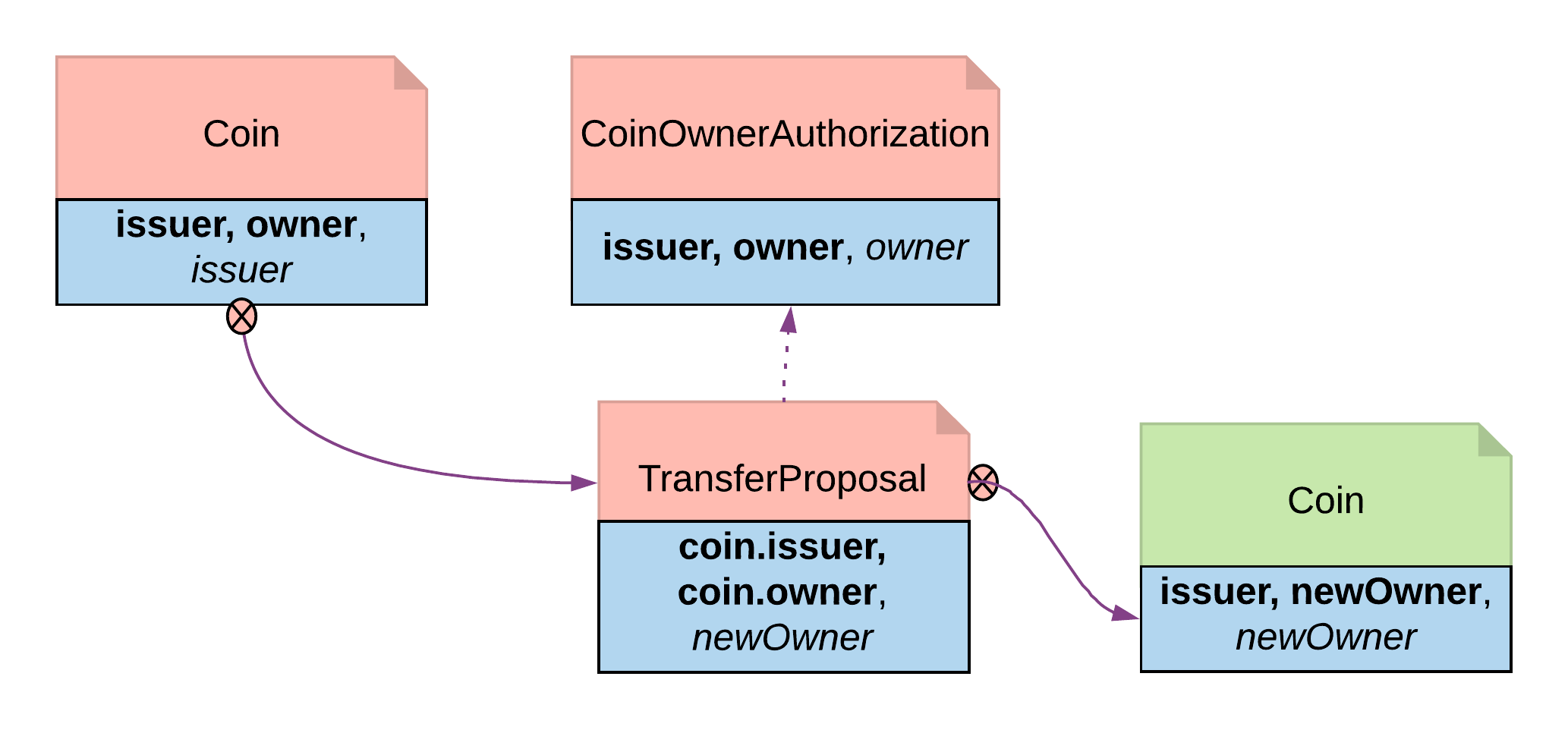
For example, an issuer wants to ensure that only accredited parties can receive coin transfers. The issuer creates an authorization token for approved owners:
```haskell theme={"theme":{"light":"github-light","dark":"github-dark"}}
template CoinOwnerAuthorization
with
owner: Party
issuer: Party
where
signatory issuer
observer owner
choice WithdrawAuthorization
: ()
controller issuer
do return ()
```
The `AcceptTransfer` choice on `TransferProposal` requires the new owner to supply their authorization token. The asserts verify the token matches the issuer and the new owner:
```haskell theme={"theme":{"light":"github-light","dark":"github-dark"}}
choice AcceptTransfer
: ContractId Coin
with token: ContractId CoinOwnerAuthorization
controller newOwner
do
t <- fetch token
assert (coin.issuer == t.issuer)
assert (newOwner == t.owner)
create coin with owner = newOwner
```
If the issuer withdraws the authorization before the transfer is accepted, the transfer fails.
### Authorization
Verifies that a controlling party has the right permissions before they take certain actions. An authorization contract serves as proof — the choice body checks for its existence and validity before proceeding.
Authorization is a universal concept in the business world, as access to most business resources is a privilege and not given freely. For example, security trading may seem to be a plain bilateral agreement between the two trading counterparties, but this could not be further from the truth. To be able to trade, the trading parties need to go through a series of authorization processes and gain permission from a list of service providers such as exchanges, market data streaming services, clearing houses, and security registrars.
The Authorization pattern shows how to model these authorization checks prior to a business transaction.
For example, an issuer wants to ensure that only accredited parties can receive coin transfers. The issuer creates an authorization token for approved owners:
```haskell theme={"theme":{"light":"github-light","dark":"github-dark"}}
template CoinOwnerAuthorization
with
owner: Party
issuer: Party
where
signatory issuer
observer owner
choice WithdrawAuthorization
: ()
controller issuer
do return ()
```
The `AcceptTransfer` choice on `TransferProposal` requires the new owner to supply their authorization token. The asserts verify the token matches the issuer and the new owner:
```haskell theme={"theme":{"light":"github-light","dark":"github-dark"}}
choice AcceptTransfer
: ContractId Coin
with token: ContractId CoinOwnerAuthorization
controller newOwner
do
t <- fetch token
assert (coin.issuer == t.issuer)
assert (newOwner == t.owner)
create coin with owner = newOwner
```
If the issuer withdraws the authorization before the transfer is accepted, the transfer fails.
 ### Locking
Prevents choices from being exercised on a contract while it is in a locked state. Useful for scenarios like securities settlement where assets must be frozen during clearing.
Locking is a common real-life requirement in business transactions. During the clearing and settlement process, once a trade is registered and novated to a central clearing house, the trade is considered locked-in. This means the securities under the ownership of the seller need to be locked so they cannot be used for other purposes, and so should the funds on the buyer's account. The locked state should remain throughout the settlement payment-versus-delivery process. Once the ownership is exchanged, the lock is lifted for the new owner to have full access.
There are three ways to achieve locking:
#### Locking by archiving
Archiving is a straightforward choice for locking because once a contract is archived, all choices on the contract become unavailable. Archiving can be done either through a consuming choice or an archiving contract.
**Consuming choice**
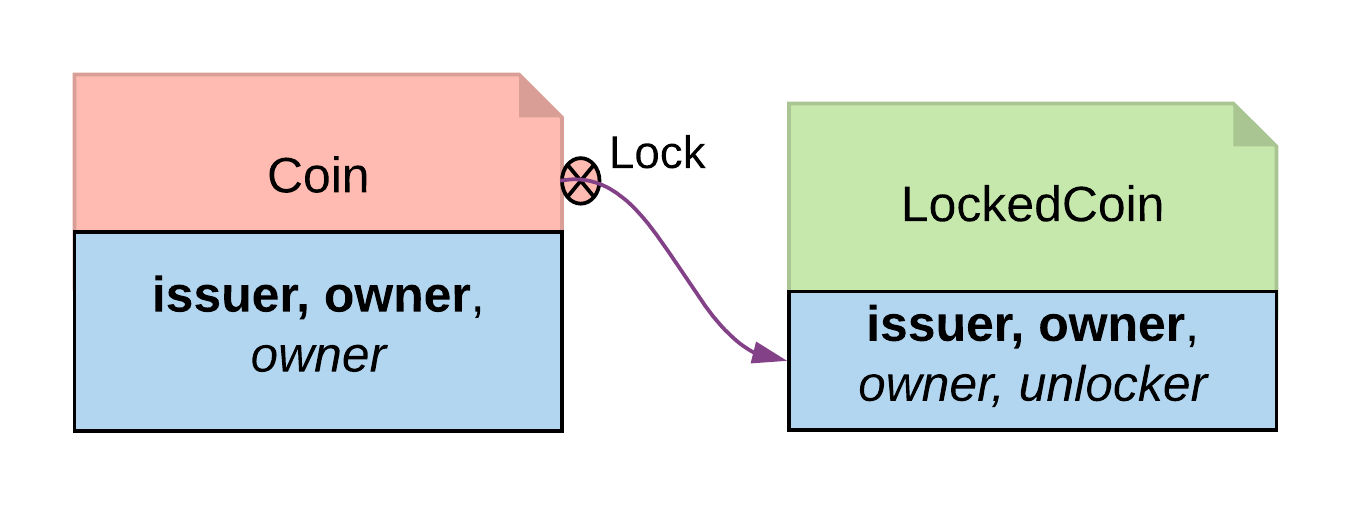
The steps below show how to use a consuming choice in the original contract to achieve locking:
* Add a consuming choice, `Lock`, to the `Coin` template that creates a `LockedCoin`.
* The controller party on `Lock` may vary depending on business context. In this example, `owner` is a good choice.
* The parameters to this choice are also subject to business use case. Normally, it should at least have locking terms (e.g. lock expiry time) and a party authorized to unlock.
```haskell theme={"theme":{"light":"github-light","dark":"github-dark"}}
choice Lock : ContractId LockedCoin
with maturity: Time; locker: Party
controller owner
do create LockedCoin with coin=this; maturity; locker
```
Create a `LockedCoin` to represent `Coin` in the locked state. `LockedCoin` has the following characteristics, all in order to be able to recreate the original `Coin`:
* The signatories are the same as the original contract.
* It has all data of `Coin`, either through having a `Coin` as a field, or by replicating all data of `Coin`.
* It has an `Unlock` choice to lift the lock.
```haskell theme={"theme":{"light":"github-light","dark":"github-dark"}}
template LockedCoin
with
coin: Coin
maturity: Time
locker: Party
where
signatory coin.issuer, coin.owner
observer locker
choice Unlock
: ContractId Coin
controller locker
do create coin
```
### Locking
Prevents choices from being exercised on a contract while it is in a locked state. Useful for scenarios like securities settlement where assets must be frozen during clearing.
Locking is a common real-life requirement in business transactions. During the clearing and settlement process, once a trade is registered and novated to a central clearing house, the trade is considered locked-in. This means the securities under the ownership of the seller need to be locked so they cannot be used for other purposes, and so should the funds on the buyer's account. The locked state should remain throughout the settlement payment-versus-delivery process. Once the ownership is exchanged, the lock is lifted for the new owner to have full access.
There are three ways to achieve locking:
#### Locking by archiving
Archiving is a straightforward choice for locking because once a contract is archived, all choices on the contract become unavailable. Archiving can be done either through a consuming choice or an archiving contract.
**Consuming choice**
The steps below show how to use a consuming choice in the original contract to achieve locking:
* Add a consuming choice, `Lock`, to the `Coin` template that creates a `LockedCoin`.
* The controller party on `Lock` may vary depending on business context. In this example, `owner` is a good choice.
* The parameters to this choice are also subject to business use case. Normally, it should at least have locking terms (e.g. lock expiry time) and a party authorized to unlock.
```haskell theme={"theme":{"light":"github-light","dark":"github-dark"}}
choice Lock : ContractId LockedCoin
with maturity: Time; locker: Party
controller owner
do create LockedCoin with coin=this; maturity; locker
```
Create a `LockedCoin` to represent `Coin` in the locked state. `LockedCoin` has the following characteristics, all in order to be able to recreate the original `Coin`:
* The signatories are the same as the original contract.
* It has all data of `Coin`, either through having a `Coin` as a field, or by replicating all data of `Coin`.
* It has an `Unlock` choice to lift the lock.
```haskell theme={"theme":{"light":"github-light","dark":"github-dark"}}
template LockedCoin
with
coin: Coin
maturity: Time
locker: Party
where
signatory coin.issuer, coin.owner
observer locker
choice Unlock
: ContractId Coin
controller locker
do create coin
```
 **Archiving contract**
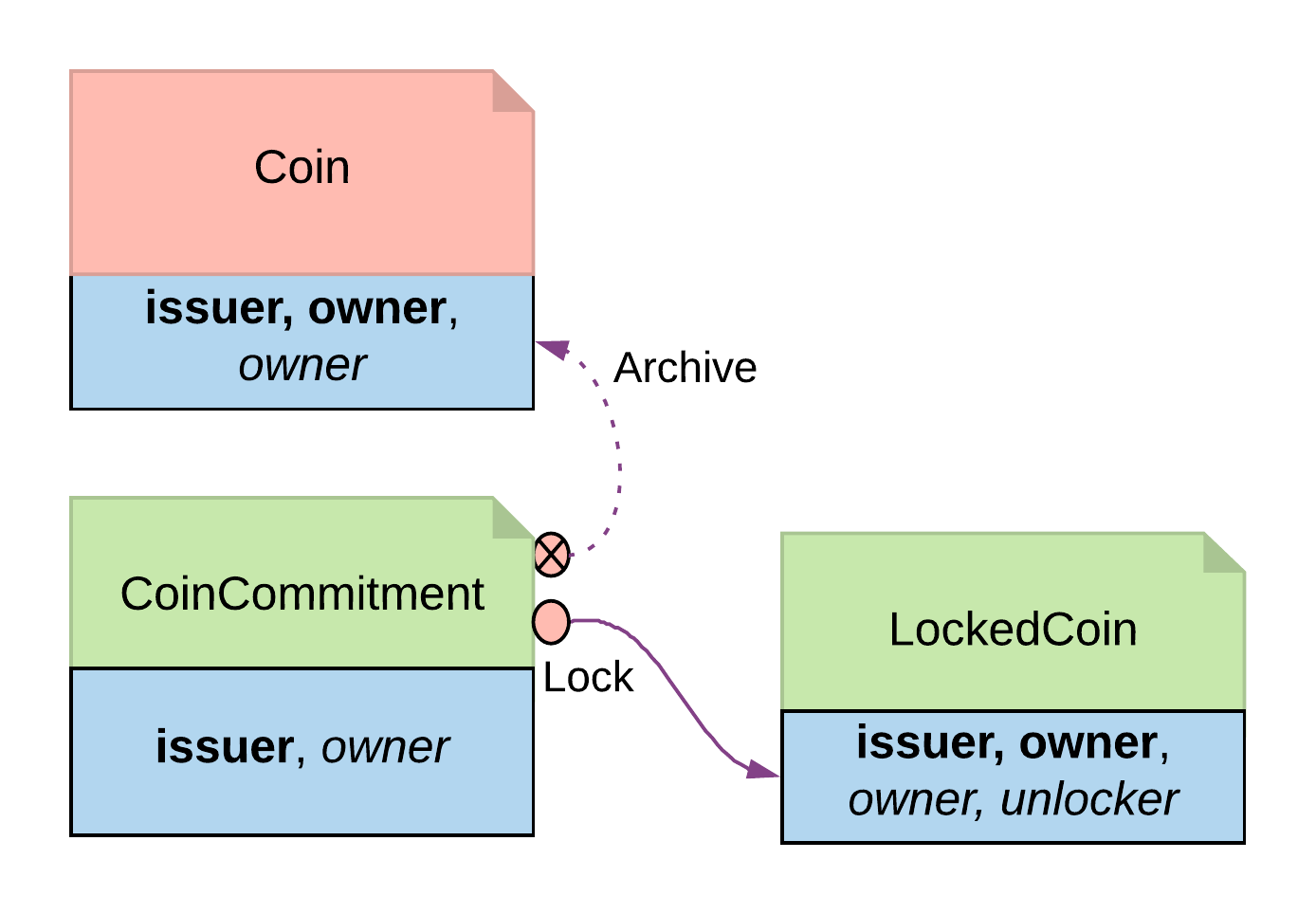
In the event that changing the original contract is not desirable, and assuming the original contract already has an `Archive` choice, you can introduce another contract, `CoinCommitment`, to archive `Coin` and create `LockedCoin`.
Examine the controller party and archiving logic in the `Archives` choice on the `Coin` contract. A coin can only be archived by the issuer under the condition that the issuer is the owner of the coin. This ensures the issuer cannot archive any coin at will:
```haskell theme={"theme":{"light":"github-light","dark":"github-dark"}}
-- a coin can only be archived by the issuer under the condition that the issuer is the owner of the coin. This ensures the issuer cannot archive coins at will.
choice Archives
: ()
controller issuer
do assert (issuer == owner)
```
Since we need to call the `Archives` choice from `CoinCommitment`, its signatory has to be the issuer. The controller party and parameters on the `Lock` choice are the same as described above for locking by consuming choice — the additional logic required is to transfer the asset to the issuer, and then explicitly call the `Archive` choice on the `Coin` contract. Once a `Coin` is archived, the `Lock` choice creates a `LockedCoin` that represents `Coin` in the locked state:
```haskell theme={"theme":{"light":"github-light","dark":"github-dark"}}
template CoinCommitment
with
owner: Party
issuer: Party
amount: Decimal
where
signatory issuer
observer owner
nonconsuming choice LockCoin
: ContractId LockedCoin
with
coinCid: ContractId Coin
maturity: Time
locker: Party
controller owner
do
inputCoin <- fetch coinCid
assert (inputCoin.owner == owner && inputCoin.issuer == issuer && inputCoin.amount == amount)
-- the original coin is transferred to the issuer, then archived
prop <- exercise coinCid Transfer with newOwner = issuer
id <- exercise prop AcceptTransfer
exercise id Archives
create LockedCoin with
coin = inputCoin with owner; issuer; amount
maturity; locker
```
**Archiving contract**
In the event that changing the original contract is not desirable, and assuming the original contract already has an `Archive` choice, you can introduce another contract, `CoinCommitment`, to archive `Coin` and create `LockedCoin`.
Examine the controller party and archiving logic in the `Archives` choice on the `Coin` contract. A coin can only be archived by the issuer under the condition that the issuer is the owner of the coin. This ensures the issuer cannot archive any coin at will:
```haskell theme={"theme":{"light":"github-light","dark":"github-dark"}}
-- a coin can only be archived by the issuer under the condition that the issuer is the owner of the coin. This ensures the issuer cannot archive coins at will.
choice Archives
: ()
controller issuer
do assert (issuer == owner)
```
Since we need to call the `Archives` choice from `CoinCommitment`, its signatory has to be the issuer. The controller party and parameters on the `Lock` choice are the same as described above for locking by consuming choice — the additional logic required is to transfer the asset to the issuer, and then explicitly call the `Archive` choice on the `Coin` contract. Once a `Coin` is archived, the `Lock` choice creates a `LockedCoin` that represents `Coin` in the locked state:
```haskell theme={"theme":{"light":"github-light","dark":"github-dark"}}
template CoinCommitment
with
owner: Party
issuer: Party
amount: Decimal
where
signatory issuer
observer owner
nonconsuming choice LockCoin
: ContractId LockedCoin
with
coinCid: ContractId Coin
maturity: Time
locker: Party
controller owner
do
inputCoin <- fetch coinCid
assert (inputCoin.owner == owner && inputCoin.issuer == issuer && inputCoin.amount == amount)
-- the original coin is transferred to the issuer, then archived
prop <- exercise coinCid Transfer with newOwner = issuer
id <- exercise prop AcceptTransfer
exercise id Archives
create LockedCoin with
coin = inputCoin with owner; issuer; amount
maturity; locker
```
 This pattern achieves locking in a fairly straightforward way. However, there are some trade-offs:
* Locking by archiving disables all choices on the original contract. Usually for consuming choices this is exactly what is required, but if a party needs to selectively lock only some choices, remaining active choices need to be replicated on the `LockedCoin` contract, which can lead to code duplication.
* The choices on the original contract need to be altered for the lock choice to be added. If this contract is shared across multiple participants, it will require agreement from all involved.
#### Locking by state change
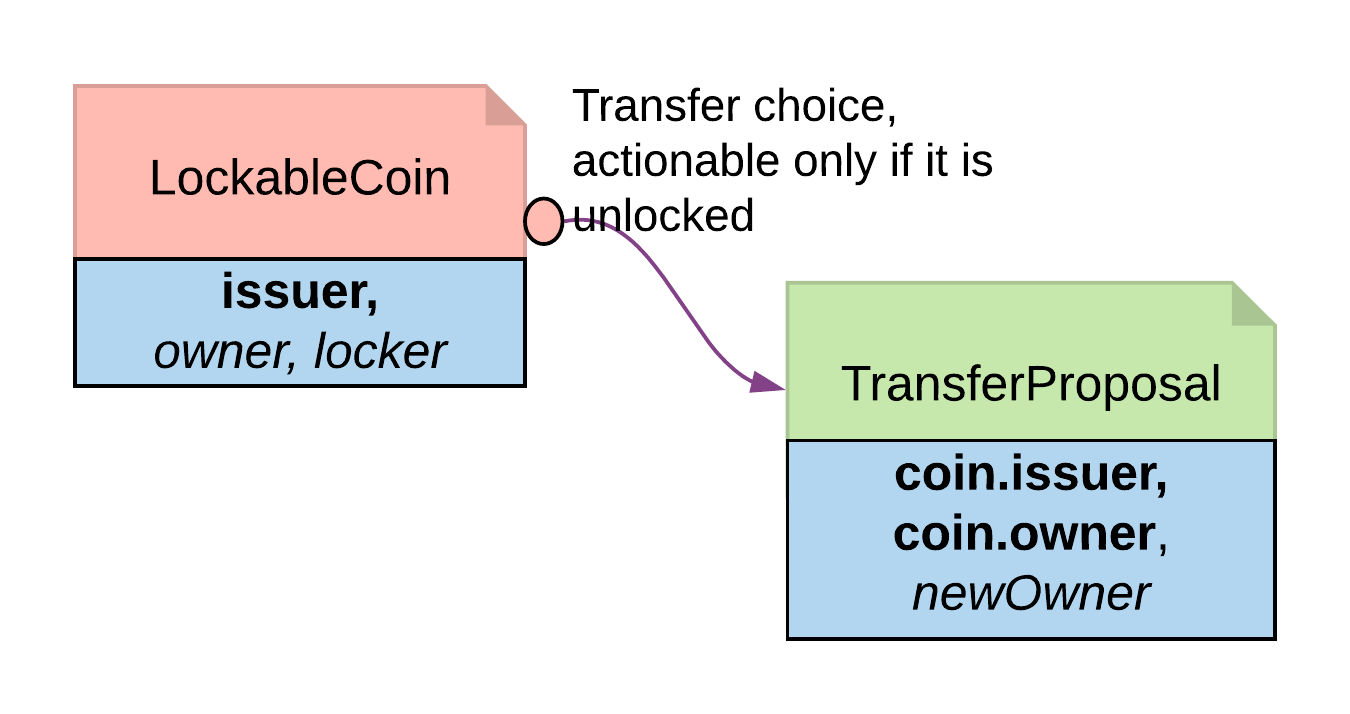
In its original form, all choices on `Coin` are actionable as long as the contract is active. Locking by state requires introducing fields to track state. This allows for the creation of an active contract in two possible states: locked or unlocked. A Daml modeler can selectively make certain choices actionable only if the contract is in an unlocked state. This effectively makes the asset lockable.
The state can be stored in many ways. This example demonstrates how to create a `LockableCoin` through a party. Alternatively, you can add a lock contract to the asset contract, use a boolean flag, or include lock activation and expiry terms as part of the template parameters.
Here are the changes made to the original `Coin` contract to make it lockable:
* Add a `locker` party to the template parameters.
* Define the states: if `owner == locker`, the coin is unlocked; if `owner != locker`, the coin is in a locked state.
* The contract state is checked on choices: `Transfer` is only actionable if the coin is unlocked; `Lock` is only actionable if the coin is unlocked and a third-party locker is supplied; `Unlock` is available to the locker party only if the coin is locked.
```haskell theme={"theme":{"light":"github-light","dark":"github-dark"}}
template LockableCoin
with
owner: Party
issuer: Party
amount: Decimal
locker: Party
where
signatory issuer, owner
observer locker
ensure amount > 0.0
-- Transfer can only happen if not locked
choice Transfer : ContractId TransferProposal
with newOwner: Party
controller owner
do
assert (locker == owner)
create TransferProposal with coin=this; newOwner
-- Lock by bringing a locker on board
choice Lock : ContractId LockableCoin
with newLocker: Party
controller owner
do
assert (newLocker /= owner)
create this with locker = newLocker
-- Unlock restores owner control
choice Unlock
: ContractId LockableCoin
controller locker
do
assert (locker /= owner)
create this with locker = owner
```
This pattern achieves locking in a fairly straightforward way. However, there are some trade-offs:
* Locking by archiving disables all choices on the original contract. Usually for consuming choices this is exactly what is required, but if a party needs to selectively lock only some choices, remaining active choices need to be replicated on the `LockedCoin` contract, which can lead to code duplication.
* The choices on the original contract need to be altered for the lock choice to be added. If this contract is shared across multiple participants, it will require agreement from all involved.
#### Locking by state change
In its original form, all choices on `Coin` are actionable as long as the contract is active. Locking by state requires introducing fields to track state. This allows for the creation of an active contract in two possible states: locked or unlocked. A Daml modeler can selectively make certain choices actionable only if the contract is in an unlocked state. This effectively makes the asset lockable.
The state can be stored in many ways. This example demonstrates how to create a `LockableCoin` through a party. Alternatively, you can add a lock contract to the asset contract, use a boolean flag, or include lock activation and expiry terms as part of the template parameters.
Here are the changes made to the original `Coin` contract to make it lockable:
* Add a `locker` party to the template parameters.
* Define the states: if `owner == locker`, the coin is unlocked; if `owner != locker`, the coin is in a locked state.
* The contract state is checked on choices: `Transfer` is only actionable if the coin is unlocked; `Lock` is only actionable if the coin is unlocked and a third-party locker is supplied; `Unlock` is available to the locker party only if the coin is locked.
```haskell theme={"theme":{"light":"github-light","dark":"github-dark"}}
template LockableCoin
with
owner: Party
issuer: Party
amount: Decimal
locker: Party
where
signatory issuer, owner
observer locker
ensure amount > 0.0
-- Transfer can only happen if not locked
choice Transfer : ContractId TransferProposal
with newOwner: Party
controller owner
do
assert (locker == owner)
create TransferProposal with coin=this; newOwner
-- Lock by bringing a locker on board
choice Lock : ContractId LockableCoin
with newLocker: Party
controller owner
do
assert (newLocker /= owner)
create this with locker = newLocker
-- Unlock restores owner control
choice Unlock
: ContractId LockableCoin
controller locker
do
assert (locker /= owner)
create this with locker = owner
```
 Trade-offs:
* It requires changes made to the original contract template. Furthermore, every choice intended to be locked needs to change too.
* If locking and unlocking terms (e.g. lock triggering event, expiry time, etc.) need to be added to the template parameters to track the state change, the template can get overloaded.
#### Locking by safekeeping
Safekeeping is a realistic way to model locking, as it is a common practice in many industries. For example, during a real estate transaction, purchase funds are transferred to the seller's lawyer's escrow account after the contract is signed and before closing.
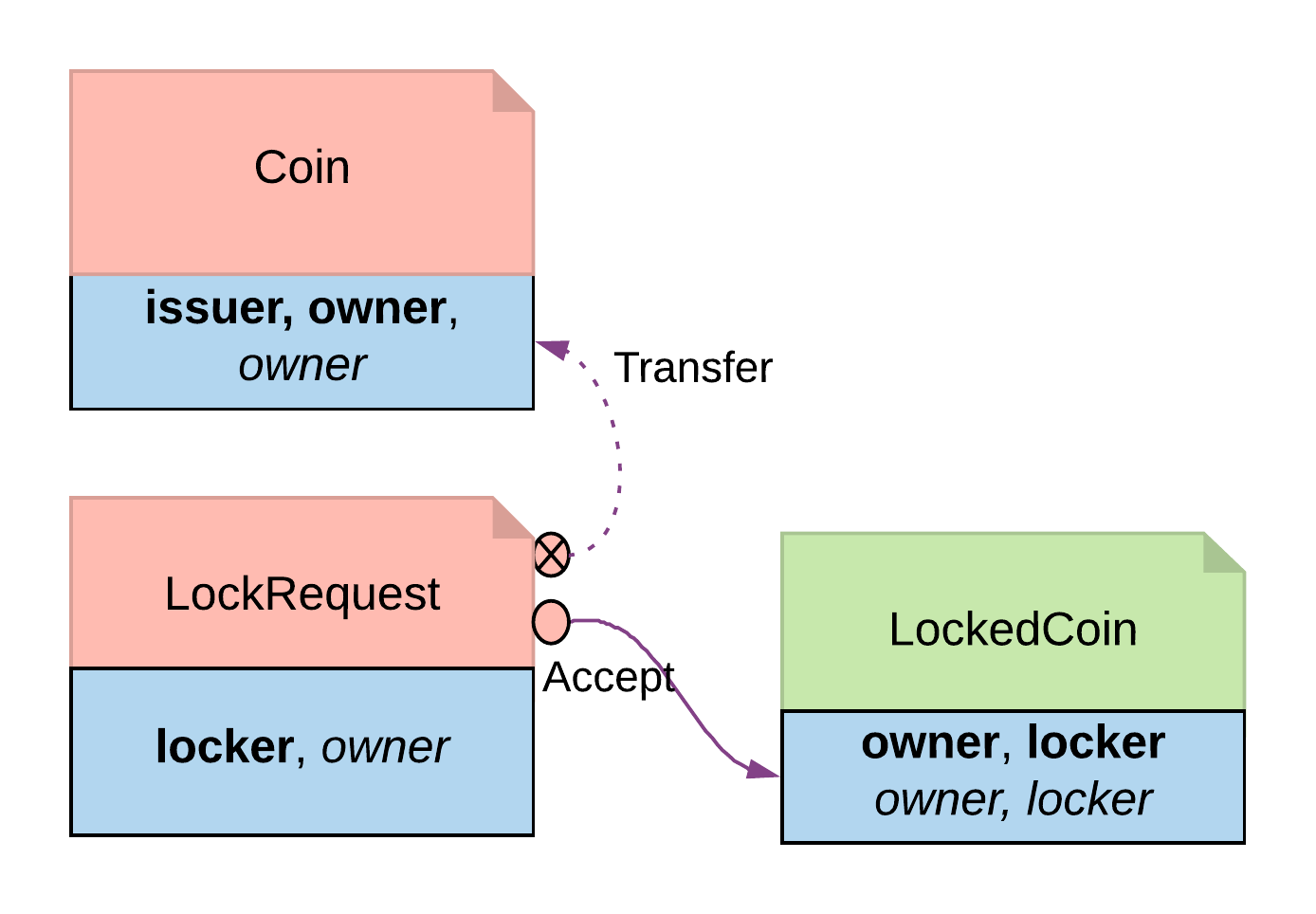
There is no need to make a change to the original contract. With two additional contracts, we can transfer the `Coin` ownership to a locker party:
* `LockRequest` has a locker party as the single signatory, allowing the locker party to unilaterally initiate the process and specify locking terms.
* Once the owner exercises `Accept` on the lock request, the ownership of the coin is transferred to the locker.
* The `Accept` choice also creates a `LockedCoinV2` that represents `Coin` in the locked state.
```haskell theme={"theme":{"light":"github-light","dark":"github-dark"}}
template LockRequest
with
locker: Party
maturity: Time
coin: Coin
where
signatory locker
observer coin.owner
choice Accept : LockResult
with coinCid : ContractId Coin
controller coin.owner
do
inputCoin <- fetch coinCid
assert (inputCoin == coin)
tpCid <- exercise coinCid Transfer with newOwner = locker
coinCid <- exercise tpCid AcceptTransfer
lockCid <- create LockedCoinV2 with locker; maturity; coin
return LockResult {coinCid; lockCid}
```
`LockedCoinV2` represents `Coin` in the locked state. It is fairly similar to the `LockedCoin` described above for locking by consuming choice. The additional logic is to transfer ownership from the locker back to the owner when `Unlock` or `Clawback` is called:
```haskell theme={"theme":{"light":"github-light","dark":"github-dark"}}
template LockedCoinV2
with
coin: Coin
maturity: Time
locker: Party
where
signatory locker, coin.owner
choice UnlockV2
: ContractId Coin
with coinCid : ContractId Coin
controller locker
do
inputCoin <- fetch coinCid
assert (inputCoin.owner == locker)
tpCid <- exercise coinCid Transfer with newOwner = coin.owner
exercise tpCid AcceptTransfer
choice ClawbackV2
: ContractId Coin
with coinCid : ContractId Coin
controller coin.owner
do
currTime <- getTime
assert (currTime >= maturity)
inputCoin <- fetch coinCid
assert (inputCoin == coin with owner=locker)
tpCid <- exercise coinCid Transfer with newOwner = coin.owner
exercise tpCid AcceptTransfer
```
Trade-offs:
* It requires changes made to the original contract template. Furthermore, every choice intended to be locked needs to change too.
* If locking and unlocking terms (e.g. lock triggering event, expiry time, etc.) need to be added to the template parameters to track the state change, the template can get overloaded.
#### Locking by safekeeping
Safekeeping is a realistic way to model locking, as it is a common practice in many industries. For example, during a real estate transaction, purchase funds are transferred to the seller's lawyer's escrow account after the contract is signed and before closing.
There is no need to make a change to the original contract. With two additional contracts, we can transfer the `Coin` ownership to a locker party:
* `LockRequest` has a locker party as the single signatory, allowing the locker party to unilaterally initiate the process and specify locking terms.
* Once the owner exercises `Accept` on the lock request, the ownership of the coin is transferred to the locker.
* The `Accept` choice also creates a `LockedCoinV2` that represents `Coin` in the locked state.
```haskell theme={"theme":{"light":"github-light","dark":"github-dark"}}
template LockRequest
with
locker: Party
maturity: Time
coin: Coin
where
signatory locker
observer coin.owner
choice Accept : LockResult
with coinCid : ContractId Coin
controller coin.owner
do
inputCoin <- fetch coinCid
assert (inputCoin == coin)
tpCid <- exercise coinCid Transfer with newOwner = locker
coinCid <- exercise tpCid AcceptTransfer
lockCid <- create LockedCoinV2 with locker; maturity; coin
return LockResult {coinCid; lockCid}
```
`LockedCoinV2` represents `Coin` in the locked state. It is fairly similar to the `LockedCoin` described above for locking by consuming choice. The additional logic is to transfer ownership from the locker back to the owner when `Unlock` or `Clawback` is called:
```haskell theme={"theme":{"light":"github-light","dark":"github-dark"}}
template LockedCoinV2
with
coin: Coin
maturity: Time
locker: Party
where
signatory locker, coin.owner
choice UnlockV2
: ContractId Coin
with coinCid : ContractId Coin
controller locker
do
inputCoin <- fetch coinCid
assert (inputCoin.owner == locker)
tpCid <- exercise coinCid Transfer with newOwner = coin.owner
exercise tpCid AcceptTransfer
choice ClawbackV2
: ContractId Coin
with coinCid : ContractId Coin
controller coin.owner
do
currTime <- getTime
assert (currTime >= maturity)
inputCoin <- fetch coinCid
assert (inputCoin == coin with owner=locker)
tpCid <- exercise coinCid Transfer with newOwner = coin.owner
exercise tpCid AcceptTransfer
```
 Ownership transfer may give the locking party too much access to the locked asset. A rogue lawyer could run away with the funds. In a similar fashion, a malicious locker party could introduce code to transfer assets away while they are under their ownership.
### Multiple party agreement
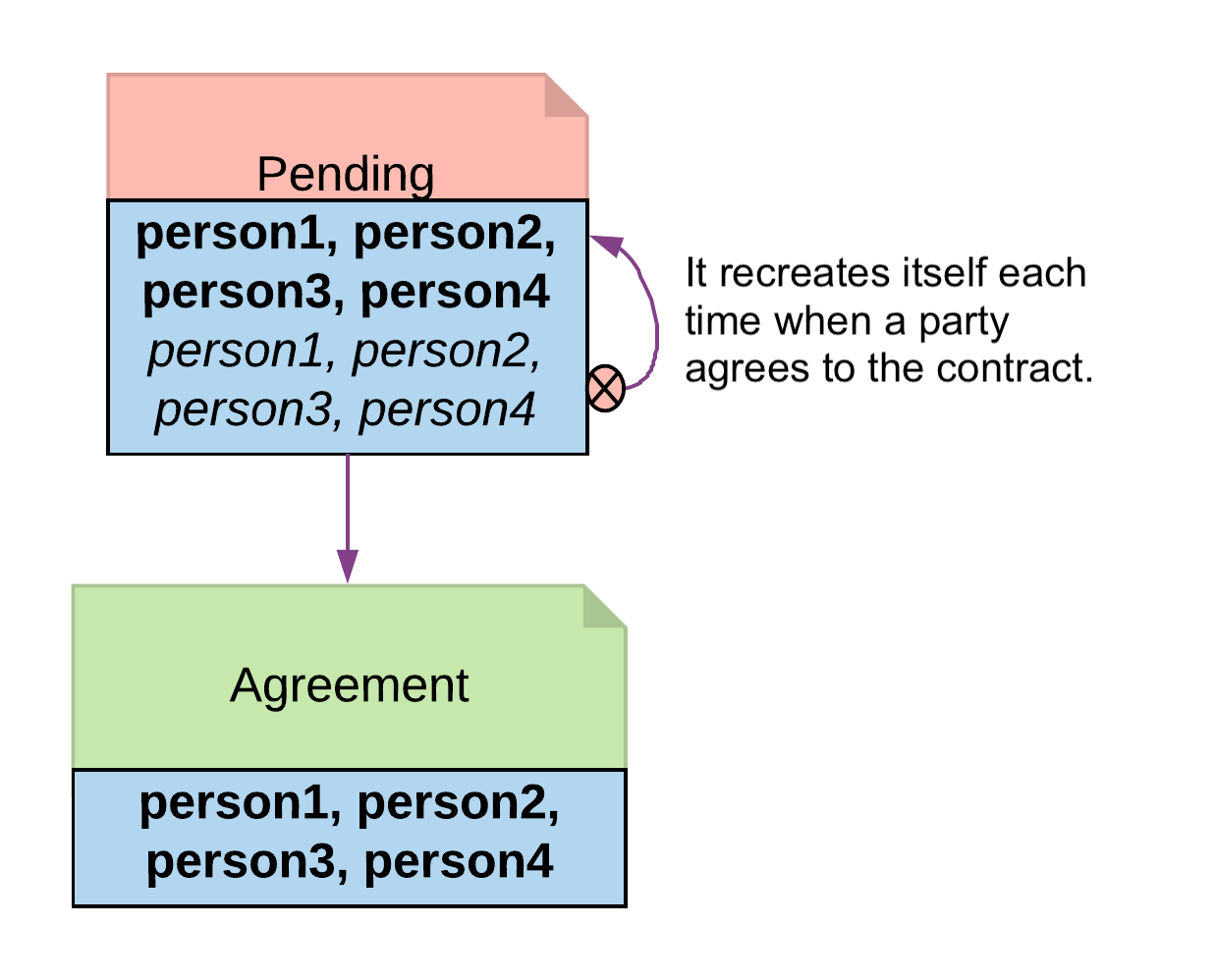
Collects signatures from more than two parties. A `Pending` contract wraps the final `Agreement` and tracks who has signed. Each party signs by exercising a `Sign` choice, and once all parties have signed, any of them can `Finalize` to create the agreement.
Propose-Accept (above) shows how to create bilateral agreements in Daml. However, a project or a workflow often requires more than two parties to reach a consensus and put their signatures on a multi-party contract. For example, in a large construction project, there are at least three major stakeholders: owner, architect, and builder. All three parties need to establish agreement on key responsibilities and project success criteria before starting the construction.
If such an agreement were modeled as three separate bilateral agreements, no party could be sure if there are conflicts between their two contracts and the third contract between their partners. If Propose-Accept were used to collect three signatures on a multi-party agreement, unnecessary restrictions would be put on the order of consensus, and a number of additional contract templates would be needed as intermediate steps. Both solutions are suboptimal.
Following the Multiple Party Agreement pattern, it is easy to write an agreement contract with multiple signatories and have each party accept explicitly.
The final agreement contract has multiple signatories:
```haskell theme={"theme":{"light":"github-light","dark":"github-dark"}}
template Agreement
with
signatories: [Party]
where
signatory signatories
ensure unique signatories
```
The `Pending` contract collects signatures one by one. It is observable by all required signatories, so each can see when it is their turn to sign:
```haskell theme={"theme":{"light":"github-light","dark":"github-dark"}}
toSign : Pending -> [Party]
toSign Pending { alreadySigned, finalContract } =
filter (`notElem` alreadySigned) finalContract.signatories
template Pending
with
finalContract: Agreement
alreadySigned: [Party]
where
signatory alreadySigned
observer finalContract.signatories
ensure unique alreadySigned
choice Sign : ContractId Pending with
signer : Party
controller signer
do
assert (signer `elem` toSign this)
create this with alreadySigned = signer :: alreadySigned
choice Finalize : ContractId Agreement with
signer : Party
controller signer
do
assert (sort alreadySigned == sort finalContract.signatories)
create finalContract
```
One party kicks off the workflow by creating a `Pending` contract listing only themselves as signed. The others sign in any order, and once complete, any signatory can finalize:
```haskell theme={"theme":{"light":"github-light","dark":"github-dark"}}
-- Any party can kick off by creating a Pending listing only themselves
pending <- person1 `submit` do
createCmd Pending with finalContract; alreadySigned = [person1]
-- Each party signs
pending <- person2 `submit` do exerciseCmd pending Sign with signer = person2
pending <- person3 `submit` do exerciseCmd pending Sign with signer = person3
pending <- person4 `submit` do exerciseCmd pending Sign with signer = person4
-- Once all have signed, any signatory can finalize
person1 `submit` do exerciseCmd pending Finalize with signer = person1
```
Ownership transfer may give the locking party too much access to the locked asset. A rogue lawyer could run away with the funds. In a similar fashion, a malicious locker party could introduce code to transfer assets away while they are under their ownership.
### Multiple party agreement
Collects signatures from more than two parties. A `Pending` contract wraps the final `Agreement` and tracks who has signed. Each party signs by exercising a `Sign` choice, and once all parties have signed, any of them can `Finalize` to create the agreement.
Propose-Accept (above) shows how to create bilateral agreements in Daml. However, a project or a workflow often requires more than two parties to reach a consensus and put their signatures on a multi-party contract. For example, in a large construction project, there are at least three major stakeholders: owner, architect, and builder. All three parties need to establish agreement on key responsibilities and project success criteria before starting the construction.
If such an agreement were modeled as three separate bilateral agreements, no party could be sure if there are conflicts between their two contracts and the third contract between their partners. If Propose-Accept were used to collect three signatures on a multi-party agreement, unnecessary restrictions would be put on the order of consensus, and a number of additional contract templates would be needed as intermediate steps. Both solutions are suboptimal.
Following the Multiple Party Agreement pattern, it is easy to write an agreement contract with multiple signatories and have each party accept explicitly.
The final agreement contract has multiple signatories:
```haskell theme={"theme":{"light":"github-light","dark":"github-dark"}}
template Agreement
with
signatories: [Party]
where
signatory signatories
ensure unique signatories
```
The `Pending` contract collects signatures one by one. It is observable by all required signatories, so each can see when it is their turn to sign:
```haskell theme={"theme":{"light":"github-light","dark":"github-dark"}}
toSign : Pending -> [Party]
toSign Pending { alreadySigned, finalContract } =
filter (`notElem` alreadySigned) finalContract.signatories
template Pending
with
finalContract: Agreement
alreadySigned: [Party]
where
signatory alreadySigned
observer finalContract.signatories
ensure unique alreadySigned
choice Sign : ContractId Pending with
signer : Party
controller signer
do
assert (signer `elem` toSign this)
create this with alreadySigned = signer :: alreadySigned
choice Finalize : ContractId Agreement with
signer : Party
controller signer
do
assert (sort alreadySigned == sort finalContract.signatories)
create finalContract
```
One party kicks off the workflow by creating a `Pending` contract listing only themselves as signed. The others sign in any order, and once complete, any signatory can finalize:
```haskell theme={"theme":{"light":"github-light","dark":"github-dark"}}
-- Any party can kick off by creating a Pending listing only themselves
pending <- person1 `submit` do
createCmd Pending with finalContract; alreadySigned = [person1]
-- Each party signs
pending <- person2 `submit` do exerciseCmd pending Sign with signer = person2
pending <- person3 `submit` do exerciseCmd pending Sign with signer = person3
pending <- person4 `submit` do exerciseCmd pending Sign with signer = person4
-- Once all have signed, any signatory can finalize
person1 `submit` do exerciseCmd pending Finalize with signer = person1
```